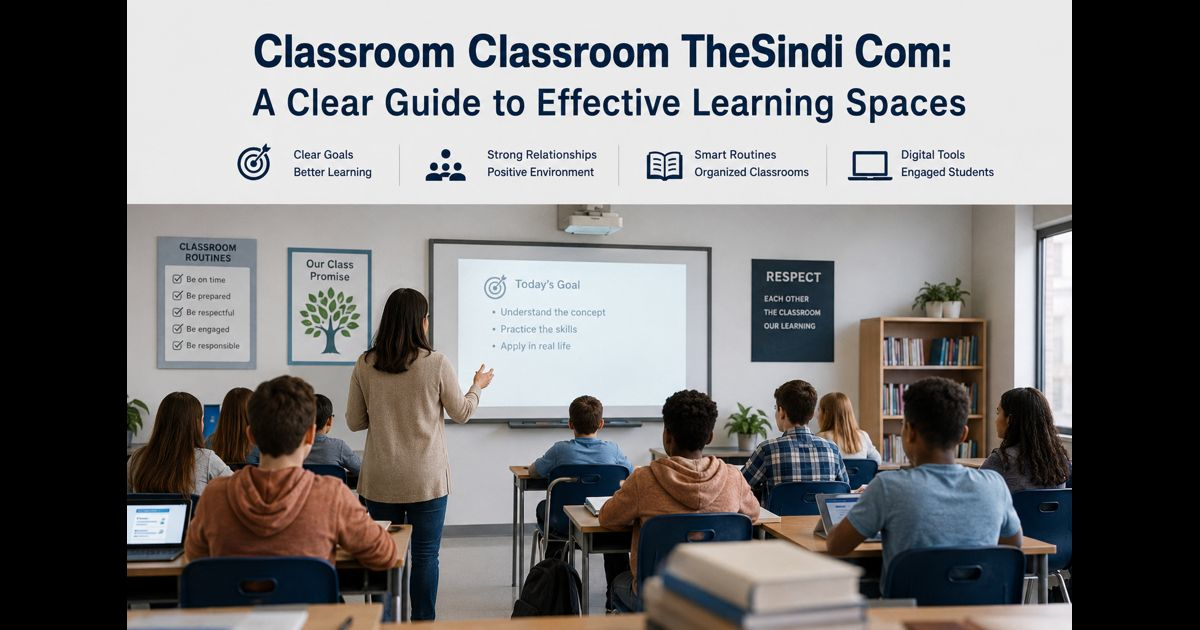
Classroom classroom TheSindi com can refer to classroom-related information associated with TheSindi.com, but it is not the established name of a separate teaching platform or an official Google Classroom address. The repeated word may appear in browser histories, analytics reports, copied page labels or navigation data.
A classroom can be physical, virtual or blended. In every format, its quality depends on more than desks, rules or software. Students need clear expectations, accessible materials, purposeful instruction, opportunities to participate and reliable ways to receive help.
TheSindi com publishes general information across technology, business, artificial intelligence and digital knowledge. Readers looking for a school-managed class, assignment or teacher announcement should use the address supplied by their school rather than assuming that an unrelated publication hosts the course.
Classroom and Google Classroom Are Not the Same
A classroom is the complete learning environment. It includes students, teachers, lessons, relationships, routines, resources, assessment and the physical or virtual space in which learning occurs.
Google Classroom is a digital service within Google Workspace for Education. According to Google’s official overview, schools can use it to organize assignments, support communication and connect with tools such as Google Docs, Gmail and Google Calendar.
Google Classroom may support a course, but it does not replace the teaching decisions that make the course effective. A neatly organized dashboard cannot compensate for unclear instructions, inaccessible material, inconsistent feedback or activities that give students no meaningful role.
|
Area |
Classroom |
Google Classroom |
|
Meaning |
The full teaching and learning environment |
A digital class-management service |
|
Location |
School room, online space or blended setting |
Web browser and mobile application |
|
Main components |
Instruction, relationships, routines, assessment and resources |
Posts, assignments, files, grades and communication tools |
|
Responsibility |
Teachers, students, school leaders and support staff |
Account administrators, teachers and authorized users |
|
Access |
Determined by the school or learning setting |
Usually requires an eligible Google account and class access |
The Foundations of an Effective Classroom
An effective classroom is organized around learning rather than control. Order matters because interruptions reduce instructional time, but silence and compliance alone do not demonstrate understanding.
Evidence reviewed by the NSW Centre for Education Statistics and Evaluation supports combining preventive and responsive classroom-management practices, with greater emphasis on prevention. Teachers reduce many avoidable problems when they establish expectations, teach routines, prepare suitable activities and identify barriers before they become disruptions.
Five elements work together.
Clear Learning Goals
Students should know what they are expected to learn, what successful work looks like and how the activity connects to the broader lesson.
A useful objective is specific enough to guide action. “Understand fractions” gives little direction. “Compare two fractions with different denominators and explain the comparison” identifies both the skill and the expected evidence.
Teachers can reinforce the goal by:
- Stating it in age-appropriate language
- Showing an example of successful work
- Checking whether students can explain the goal
- Returning to it before the lesson ends
The goal should guide the activity. It should not exist merely as text on a board or slide.
Explicitly Taught Routines
Students cannot follow a procedure that has never been demonstrated. Entry, transitions, group work, material collection, independent practice and lesson closure all benefit from routines that are taught and rehearsed.
The Australian Education Research Organisation explains that explicitly taught routines provide structure, predictability and consistency. These qualities reduce uncertainty and allow more attention to remain on learning.
A sound routine answers four questions:
- When does it begin?
- What should each student do?
- What resources are needed?
- How does everyone know it is complete?
Routines should reduce unnecessary decisions, not remove every opportunity for independence.
Positive Teacher–Student Relationships
Students are more likely to participate when correction is fair, assistance is available and their contributions are treated seriously. A positive relationship does not require a teacher to lower academic or behavioral expectations. It allows high expectations to be communicated with dignity.
Useful practices include:
- Learning and correctly pronouncing students’ names
- Correcting behavior privately when possible
- Separating a student’s action from the student’s identity
- Listening before drawing conclusions
- Applying expectations consistently
- Recognizing improvement as well as high performance
Public humiliation, sarcasm and unpredictable consequences can damage trust even when they produce temporary compliance.
Active Participation
Long periods of passive listening make it difficult to determine who understands the lesson. Participation gives teachers observable evidence and gives students opportunities to process ideas.
Participation can include:
- Brief written responses
- Structured partner discussion
- Worked examples
- Practical demonstrations
- Retrieval questions
- Group problem-solving
- Student explanations
- Exit tickets
Activities need clear participation rules. Telling students to “discuss” may produce uneven involvement; assigning a question, time limit, speaking order and expected output makes the task easier to follow.
Timely Checks for Understanding
Waiting for a final test can allow misconceptions to continue for days or weeks. Short checks during instruction help a teacher decide whether to proceed, explain differently or provide additional practice.
A check for understanding should influence the next action. If many students answer incorrectly, repeating the same explanation more loudly is unlikely to solve the problem. The teacher may need a new example, a visual representation, a smaller step or guided practice.
Designing the Physical Classroom
Room design should support the activities students perform most often. There is no universally correct seating plan.
Rows can help students focus during direct instruction or individual assessment. Pairs allow quick discussion. Groups support collaboration but may increase distraction when roles are unclear. A flexible arrangement can serve several purposes if transitions are safe and efficient.
When evaluating the room, consider:
- Whether every student can see essential material
- Whether the teacher can reach students who need assistance
- Whether movement routes remain clear
- Whether frequently used materials are easy to obtain and return
- Whether noise from one activity interferes with another
- Whether seating accommodates mobility, sensory and attention needs
- Whether emergency exits and safety equipment remain accessible
Wall displays should serve a purpose. Relevant vocabulary, worked examples and current student work can reinforce learning. Excessive visual material may compete for attention, particularly when displays are crowded or unrelated to the current unit.
Organizing a Digital Classroom
A digital classroom should make the next required action easy to identify. Students should not have to inspect several posts, folders and messages to determine what is due.
A reliable structure includes:
- Consistent names for lessons and assignments
- One visible location for current work
- Clear due dates and submission instructions
- Accessible file formats
- A predictable method for questions
- Written explanations alongside important video or audio material
- A process for missed work and technical failure
- Archived or separated material from completed units
Technology should be selected for an instructional reason. A new application is not automatically more engaging, and switching between too many services can increase confusion.
Before assigning a digital activity, confirm that students understand how to open the material, complete the task, save their work and submit it. Provide an alternative process when a device, connection or account fails.
Accessibility and Inclusion
An inclusive classroom removes avoidable barriers without reducing the intellectual value of the lesson. Students may differ in language background, prior knowledge, reading ability, mobility, vision, hearing, attention and access to technology.
Practical measures include:
- Using readable fonts and sufficient color contrast
- Adding captions to instructional videos
- Providing text alternatives for important audio content
- Writing descriptive link labels instead of “click here”
- Explaining unfamiliar vocabulary
- Allowing appropriate methods for demonstrating understanding
- Breaking complex directions into ordered steps
- Checking compatibility with assistive technology
- Avoiding unnecessary time pressure
- Supplying equivalent offline material when access is unreliable
Accessibility should be considered during lesson preparation. Retrofitting material after a student encounters a barrier can delay participation and single that student out.
Privacy and Safety in Digital Learning
Digital convenience does not remove a school’s responsibility to protect student information. Teachers should use institution-approved accounts, applications and sharing settings.
Before introducing a service, schools should determine:
- What student information it collects
- Who can view submitted work
- Whether public profiles are created
- How long information is retained
- Whether student activity is used for advertising or unrelated profiling
- How guardians and students receive required notices
- What happens when an account is closed
Students should not be instructed to post personal information publicly merely to complete an assignment. Public links, open discussion boards and shared documents require deliberate permission settings.
Artificial intelligence tools need similar scrutiny. Students should know when AI use is permitted, what assistance must be disclosed and which personal or confidential material must never be entered. Teachers should independently verify AI-generated explanations, examples and citations before using them in instruction.
Responding to Disruption Without Escalation
Not every off-task action requires a public consequence. Effective responses are proportionate to the behavior and designed to restore learning.
A teacher may begin with:
- A pause or nonverbal reminder
- Physical proximity
- A brief restatement of the expectation
- A private conversation
- A reasonable consequence connected to the behavior
- Additional school support when the pattern continues or safety is involved
The cause matters. A student may be avoiding work because the task is confusing, inaccessible or far above the student’s current skill. Another may understand the work but need a clearer limit. Treating every disruption as defiance can hide the problem that needs attention.
Serious threats, harassment, violence or safeguarding concerns require the school’s formal procedures. Classroom techniques are not a substitute for professional or emergency support.
A Five-Minute Classroom Review
Teachers can use the following questions before or after a lesson:
Purpose
- Can students state what they are learning?
- Does the assigned activity provide evidence of that learning?
Access
- Can every student see, hear, open or otherwise use the material?
- Is an appropriate alternative available when access fails?
Participation
- Does every student have a realistic way to contribute?
- Are discussion and group-work expectations explicit?
Organization
- Are resources easy to find?
- Are transitions predictable and safe?
Feedback
- How will understanding be checked during the lesson?
- What will change if students are not ready to continue?
Climate
- Are corrections respectful and consistent?
- Can students ask for help without embarrassment?
A classroom does not need to look flawless to work well. It needs systems that protect learning, adapt to evidence and preserve students’ dignity.
Frequently Asked Questions
What does classroom classroom TheSindi com refer to?
It can refer to classroom-related information connected with TheSindi.com. It is not the established name of a standalone classroom service. The repeated word may result from a copied label, analytics entry or an attempt to locate classroom material on the website.
Is TheSindi.com Google Classroom?
No. TheSindi.com is an informational website. Google Classroom is a Google Workspace for Education service available through Google’s official domains and school-managed accounts.
What makes a classroom effective?
An effective classroom combines clear learning goals, explicitly taught routines, respectful relationships, active participation, accessible resources and regular checks for understanding.
Is classroom management mainly about discipline?
No. Discipline is only one part. Classroom management also includes lesson preparation, routines, room organization, participation structures, relationships, transitions and responses to student needs.
Can technology improve classroom learning?
Yes, when it makes useful activities, feedback, collaboration or access easier. Technology can hinder learning when it introduces distractions, privacy risks, unnecessary complexity or unequal access.
What should students do if they cannot access an online class?
They should confirm the official address provided by their school, use the correct institution-approved account and contact the teacher or school technology support. They should not enter school credentials into an unfamiliar website.
Final Thoughts
Classroom classroom TheSindi com should not be mistaken for an official school portal or a separate Google product. The useful subject behind the wording is the learning environment itself: how instruction, routines, relationships, accessibility, technology and safety work together.
A strong classroom is not measured only by quiet behavior, attractive displays or the number of digital tools in use. It is measured by whether students understand the purpose of their work, can participate safely, receive meaningful feedback and make demonstrable progress.