
Introduction
Modern organizations operate in an environment where speed, accuracy, and adaptability directly influence long-term success. As customer expectations continue to rise and business operations become more complex, relying on manual processes alone often creates unnecessary delays, higher operational costs, and avoidable errors. Companies are increasingly looking for practical ways to improve efficiency while maintaining consistent quality across every department. These improvements also support broader digital business transformation initiatives across modern organizations.
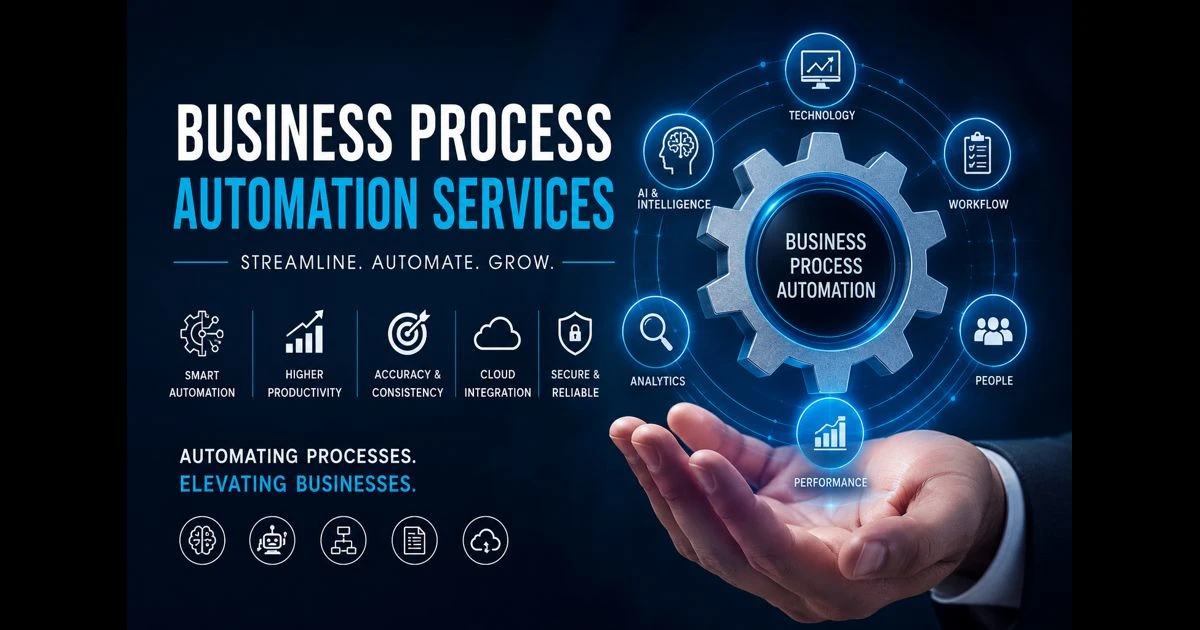
Business process automation services have become an important part of this transformation. Rather than replacing people, automation helps organizations eliminate repetitive work, standardize routine operations, and allow employees to focus on responsibilities that require creativity, strategic thinking, and decision-making. Whether an organization manages customer support, finance, human resources, sales, or supply chain operations, automation creates opportunities to improve productivity while maintaining greater operational control.
Advances in artificial intelligence, cloud computing, data integration, and workflow technologies have expanded the capabilities of automation far beyond simple task execution. Modern automation solutions can analyze information, trigger intelligent workflows, connect multiple software platforms, and provide real-time operational visibility that helps businesses make informed decisions.
This guide explores how business process automation services work, the technologies that support them, their practical business value, implementation strategies, industry applications, and the future role automation will play in building more efficient and competitive organizations.
Understanding Business Process Automation Services
Business process automation services refer to the design, implementation, and management of technologies that automate repetitive business activities with minimal manual intervention. Instead of requiring employees to complete every routine task individually, automated systems perform predefined actions according to business rules, workflows, and operational objectives.
Automation can be applied across a wide variety of organizational functions. A customer inquiry may automatically create a support ticket, notify the appropriate department, assign priority based on predefined conditions, and update management dashboards without requiring multiple employees to manually coordinate each step.
The objective extends beyond increasing speed. Effective automation creates standardized processes that improve consistency, reduce human error, strengthen compliance, and provide better visibility into organizational performance.
Unlike basic software tools that perform isolated functions, business process automation services integrate people, systems, and data into connected workflows that support daily operations across the organization.
Why Businesses Are Investing in Process Automation
Organizations of every size are under continuous pressure to improve operational performance while controlling costs. Manual workflows often become difficult to manage as companies grow, leading to duplicated work, inconsistent documentation, communication delays, and operational bottlenecks.
Business process automation addresses these challenges by creating structured workflows that operate efficiently regardless of increasing transaction volumes or organizational complexity.
Several factors continue to drive automation adoption across industries:
Improving Operational Efficiency
Automated workflows complete repetitive tasks consistently without interruptions caused by manual processing. Activities that previously required hours may be completed within minutes while maintaining predefined quality standards.
Reducing Human Error
Routine administrative work frequently involves data entry, document processing, approvals, reporting, and record management. Automation minimizes the likelihood of mistakes that may result from repetitive manual activities, helping organizations maintain higher levels of accuracy.
Supporting Business Growth
Growing businesses often struggle to scale manual operations. Automation allows organizations to increase workload capacity without expanding administrative overhead at the same rate, making growth more sustainable.
Strengthening Customer Experience
Faster response times, automated service requests, accurate order processing, and consistent communication contribute to improved customer satisfaction while reducing operational delays.
Better Decision-Making
Modern automation platforms collect operational data continuously. Managers gain access to dashboards, workflow analytics, performance metrics, and reporting that support more informed business decisions.
Core Objectives of Business Process Automation
Successful automation initiatives focus on improving business performance rather than simply replacing manual tasks. Organizations typically pursue several strategic objectives when implementing automation services.
Standardizing Business Operations
Standardized workflows ensure that similar tasks follow the same procedures regardless of department or employee, improving quality control and operational consistency.
Increasing Productivity
Employees spend less time performing repetitive administrative activities and more time on strategic work, customer engagement, innovation, and business development.
Improving Collaboration
Automated workflows connect departments by automatically routing information, approvals, documents, and notifications to the appropriate stakeholders at the correct stage of each process.
Enhancing Compliance
Many industries operate under regulatory requirements that demand accurate documentation, approval records, and process transparency. Automation creates structured audit trails that simplify compliance management.
Creating Scalable Operations
Automation provides a foundation that allows organizations to manage increasing business activity without proportional increases in operational complexity.
Characteristics of Effective Business Process Automation Services
Not every automated workflow delivers meaningful business value. High-quality business process automation services are designed around organizational objectives instead of technology alone.
Successful automation solutions typically demonstrate several important characteristics.
Process-Centered Design
Automation begins by understanding existing workflows before introducing technology. Improving inefficient processes often delivers greater value than simply automating outdated procedures.
System Integration
Modern organizations use multiple software platforms for accounting, customer relationship management, project management, communication, human resources, and data analysis. Effective automation connects these systems to eliminate unnecessary manual transfers.
Flexible Workflow Configuration
Business requirements evolve over time. Automation platforms should allow workflows to adapt without requiring complete system redevelopment whenever operational changes occur.
Data Visibility
Organizations benefit when automation provides clear operational insights through dashboards, reports, workflow monitoring, and performance analytics.
Security and Access Control
Business information requires appropriate protection. Reliable automation solutions include permission management, authentication controls, encrypted communication, and secure data handling practices that protect sensitive organizational information.
Core Technologies Powering Business Process Automation Services
The effectiveness of business process automation depends on the technologies working behind the scenes. Modern automation is no longer limited to scheduling repetitive tasks or generating automated emails. Organizations now combine multiple technologies to build connected, intelligent, and scalable business operations that improve both efficiency and decision-making.
Understanding these technologies helps businesses select automation services that align with their operational goals instead of investing in tools that solve only short-term problems.
Artificial Intelligence
Artificial intelligence enables automation systems to perform tasks that traditionally required human judgment. AI-powered automation can classify documents, understand customer requests, identify patterns within large datasets, generate insights, and support faster decision-making.
Instead of following only predefined rules, AI continuously improves through data analysis, allowing businesses to automate increasingly complex activities while maintaining high levels of accuracy.
Robotic Process Automation (RPA)
Robotic Process Automation focuses on repetitive, rule-based digital tasks. Software bots interact with business applications in much the same way employees do, performing actions such as copying information, processing invoices, updating databases, generating reports, and transferring records between systems.
RPA is particularly valuable for organizations that operate legacy software where complete system replacement is unnecessary or impractical.
Workflow Automation Platforms
Workflow automation platforms organize business activities into structured sequences that automatically assign responsibilities, trigger approvals, send notifications, and monitor progress from start to finish.
Instead of relying on email chains or manual follow-ups, organizations gain consistent workflows that improve accountability and reduce operational delays.
Cloud Computing
Cloud infrastructure has transformed automation by providing scalable, secure, and accessible environments for business applications.
Cloud-based automation services allow employees to collaborate across locations while ensuring information remains synchronized in real time. Organizations also benefit from simplified maintenance, improved system availability, and flexible resource allocation without managing extensive on-premises infrastructure.
API Integration
Businesses rarely rely on a single software platform. Customer management, finance, marketing, inventory, communication, and analytics systems often operate independently.
Application Programming Interfaces (APIs) allow these systems to exchange information automatically, creating connected business environments where data moves seamlessly without repetitive manual entry.
Data Analytics
Automation generates valuable operational information throughout every workflow.
Advanced analytics help organizations monitor performance, identify bottlenecks, evaluate productivity, measure customer interactions, and support strategic planning using reliable operational data rather than assumptions.
Types of Business Process Automation Services
Automation requirements vary depending on organizational size, industry, and operational complexity. As a result, business process automation services are available across multiple business functions instead of focusing on a single department.
Customer Relationship Management Automation
Managing customer interactions manually becomes increasingly difficult as organizations grow. Many organizations also rely on high-quality business websites to support automated customer communication and digital services.
Automation services improve customer relationship management by:
- Automatically capturing leads
- Assigning sales opportunities
- Scheduling follow-ups
- Tracking customer communication
- Managing support requests
- Updating customer records
These automated workflows create consistent customer experiences while helping sales and support teams respond more efficiently.
Human Resources Automation
Human resource departments manage large volumes of administrative work throughout the employee lifecycle.
Automation supports activities including:
- Recruitment workflows
- Candidate screening
- Employee onboarding
- Leave management
- Payroll coordination
- Performance documentation
- Training administration
Reducing repetitive administrative work allows HR professionals to focus more on workforce development and employee engagement.
Finance and Accounting Automation
Financial accuracy remains essential for every organization.
Automation services simplify financial operations by supporting:
- Invoice processing
- Expense approvals
- Payment scheduling
- Budget monitoring
- Financial reporting
- Audit documentation
- Compliance record management
These improvements reduce processing delays while strengthening financial transparency.
Marketing Automation
Marketing teams manage campaigns across multiple channels while tracking customer engagement and conversion performance.
Automation supports:
- Email campaign management
- Customer segmentation
- Lead nurturing
- Social media scheduling
- Campaign reporting
- Customer behavior analysis
This allows marketing departments to deliver more personalized communication without increasing manual workload.
Procurement Automation
Purchasing activities involve approvals, supplier communication, inventory monitoring, and contract management.
Automation improves procurement by streamlining purchase requests, vendor approvals, inventory replenishment, document management, and supplier coordination.
Customer Service Automation
Customer expectations continue to increase across industries.
Automation services improve customer support through:
- Ticket routing
- Service prioritization
- Automated acknowledgments
- Knowledge base integration
- Case tracking
- Customer feedback collection
These improvements shorten response times while maintaining consistent service quality.
Business Functions That Benefit Most from Automation
Business process automation is not limited to large enterprises. Organizations of various sizes can improve operational performance by automating processes that consume significant administrative time.
Sales Operations
Automation helps sales teams manage customer pipelines more efficiently by reducing manual updates, organizing opportunities, and ensuring timely follow-up activities.
Operations Management
Daily operational workflows often involve approvals, scheduling, resource allocation, reporting, and coordination across multiple departments.
Automation creates standardized procedures that reduce delays while improving visibility throughout the organization.
Supply Chain Management
Inventory monitoring, supplier communication, shipment tracking, and procurement workflows become more efficient when connected through automated systems that exchange information in real time.
Information Technology
IT departments automate software deployment, user account management, system monitoring, security alerts, backup scheduling, and infrastructure maintenance, allowing technical teams to focus on strategic initiatives.
Executive Management
Leadership teams gain access to operational dashboards, performance indicators, workflow analytics, and business intelligence that support faster, data-driven decision-making.
Practical Business Applications
The true value of automation becomes clear when applied to everyday business activities.
Instead of manually forwarding documents between departments, an automated workflow can validate submitted information, notify responsible managers, record approvals, archive completed documents, and generate performance reports without interrupting normal business operations.
A customer submitting an online inquiry may automatically receive confirmation, have the request categorized, be assigned to the appropriate specialist, and receive status updates throughout the resolution process.
Similarly, when a new employee joins an organization, automation can create user accounts, schedule onboarding sessions, notify department managers, prepare documentation, assign equipment requests, and monitor completion of mandatory tasks through a single coordinated workflow.
These examples demonstrate that effective business process automation services improve organizational coordination rather than simply replacing repetitive work.
Planning a Successful Business Process Automation Strategy
Technology alone does not guarantee successful automation. Organizations achieve better results when automation is introduced through careful planning, clear business objectives, and a realistic understanding of existing workflows. Businesses that automate inefficient processes without evaluating how work is currently performed often carry existing problems into new systems.
A structured automation strategy focuses on improving operational performance while ensuring employees, technology, and business goals remain aligned throughout implementation.
Identify High-Impact Processes
The first step is identifying processes that consume significant time, involve repetitive manual work, or regularly create operational delays. Automating every activity at once increases complexity and may reduce overall effectiveness.
Organizations often achieve faster results by prioritizing processes that:
- Require frequent manual data entry
- Involve multiple approval stages
- Depend on repetitive documentation
- Generate recurring customer requests
- Require consistent compliance tracking
- Produce measurable operational bottlenecks
Starting with clearly defined processes allows businesses to demonstrate measurable improvements before expanding automation across additional departments.
Evaluating Existing Workflows
Before implementing automation, businesses should understand how work currently moves across the organization. Mapping workflows often reveals unnecessary approvals, duplicated responsibilities, communication gaps, and inefficient procedures that may otherwise remain hidden.
A complete workflow evaluation typically examines:
- Process ownership
- Decision points
- Required approvals
- Data sources
- Software dependencies
- Customer interactions
- Reporting requirements
Improving workflow design before introducing automation produces stronger long-term results than simply automating outdated procedures.
Selecting the Right Automation Platform
Every organization has different operational requirements. A platform that works well for one business may not be suitable for another.
Decision-makers should evaluate automation platforms based on factors such as:
Scalability
Business requirements evolve over time. Automation software should support future expansion without requiring complete system replacement as operations grow.
Integration Capabilities
Modern businesses often rely on multiple software solutions. Automation platforms should integrate smoothly with existing systems such as CRM platforms, accounting software, communication tools, enterprise resource planning systems, and cloud services.
Security Standards
Business data requires strong protection. Automation solutions should include secure authentication, encryption, access management, activity logging, and compliance support appropriate for the organization’s industry.
Ease of Management
Automation should simplify operations rather than increase technical complexity. User-friendly workflow management allows business teams to adjust processes as operational requirements change.
Employee Adoption and Organizational Change
Automation initiatives are often viewed primarily as technology projects, yet successful implementation depends just as heavily on people.
Employees should understand that automation is designed to improve operational efficiency by reducing repetitive administrative work, allowing teams to focus on higher-value responsibilities such as customer service, strategic planning, innovation, and problem-solving.
Organizations that invest in communication, training, and gradual implementation generally experience smoother adoption and stronger long-term results.
Common Challenges During Implementation
Every automation project presents unique challenges. Understanding potential obstacles allows organizations to prepare appropriate solutions before implementation begins.
Outdated Business Processes
Automating inefficient workflows rarely solves underlying operational problems. Organizations should simplify processes before introducing automation technologies.
Poor Data Quality
Automation depends on reliable information. Inaccurate, incomplete, or inconsistent business data may produce incorrect outputs regardless of how advanced the automation platform becomes.
Maintaining accurate business information remains an essential part of successful automation.
System Compatibility
Organizations frequently operate software developed by different vendors over many years. Integrating these systems requires careful planning to ensure reliable communication between applications.
Limited Internal Expertise
Automation projects often involve technical decisions that require collaboration between operational teams, management, and technology specialists. Establishing clear responsibilities helps reduce implementation risks.
Security and Compliance Considerations
As automation manages increasing amounts of operational data, maintaining security becomes even more important.
Businesses should establish clear policies covering:
- User authentication
- Role-based access permissions
- Data encryption
- Activity monitoring
- Secure backups
- Incident response procedures
- Regulatory compliance requirements
Industries handling financial information, healthcare records, customer data, or confidential business information benefit from automation platforms that maintain detailed audit trails and support transparent governance practices.
Organizations can also follow recognized automation security best practices when developing secure operational workflows.
Measuring Automation Success
Successful automation should deliver measurable business improvements rather than simply introducing new technology.
Organizations commonly evaluate automation performance through operational indicators such as:
Process Completion Time
Comparing workflow duration before and after automation demonstrates whether efficiency has improved.
Error Reduction
Monitoring processing accuracy helps determine whether automation has reduced costly manual mistakes.
Productivity Improvements
Businesses evaluate whether employees can complete higher-value work after repetitive administrative tasks have been automated.
Customer Satisfaction
Faster response times, improved communication, and consistent service quality often contribute to stronger customer experiences.
Operational Cost Efficiency
Automation may reduce administrative overhead, improve resource utilization, and support sustainable business growth without proportionally increasing operational expenses.
Best Practices for Long-Term Success
Organizations that achieve lasting value from business process automation typically follow several practical principles.
Focus on Continuous Improvement
Business operations change over time. Automated workflows should be reviewed regularly to identify opportunities for optimization as customer expectations, regulations, and organizational priorities evolve.
Automate with Clear Business Objectives
Technology should support measurable business outcomes rather than being implemented simply because automation tools are available.
Maintain Human Oversight
Automation performs routine work efficiently, but strategic decisions, customer relationships, ethical considerations, and complex problem-solving continue to benefit from human expertise.
Build Flexible Automation Frameworks
Business environments rarely remain static. Flexible automation allows organizations to respond to market changes, organizational growth, and technological innovation without rebuilding entire operational systems.
Encourage Cross-Department Collaboration
Automation delivers the greatest value when departments work together to design workflows that improve the organization as a whole instead of optimizing isolated processes.
The Future of Business Process Automation Services
Business process automation continues to evolve as organizations seek greater operational agility, stronger customer experiences, and more informed decision-making. What began as simple rule-based automation has expanded into intelligent systems capable of supporting complex business environments.
The next generation of automation will focus on creating connected digital ecosystems where software, data, artificial intelligence, and business workflows operate together instead of functioning as isolated systems. Organizations will increasingly adopt automation that not only executes tasks but also provides insights, identifies opportunities for improvement, and supports faster strategic decisions. These developments reflect the broader evolution of technology and digital transformation across modern enterprises.
Rather than replacing employees, future automation will strengthen collaboration between people and technology by allowing teams to concentrate on innovation, customer relationships, and business growth while automated systems manage repetitive operational activities.
The Growing Role of Artificial Intelligence
Artificial intelligence is becoming one of the most influential technologies within business process automation. Modern AI systems can recognize patterns, organize large volumes of information, understand natural language, and assist with decisions that previously required significant manual effort.
As AI capabilities continue to mature, automation services are expected to become more adaptive, enabling organizations to:
- Predict workflow bottlenecks before they occur.
- Improve resource allocation using operational data.
- Deliver more personalized customer experiences.
- Detect unusual business activities that require review.
- Generate business insights from large datasets.
- Continuously improve workflow performance through data analysis.
This shift allows automation to move beyond task execution and contribute directly to operational planning and business strategy.
Automation as a Long-Term Business Strategy
Successful organizations increasingly view automation as an ongoing business capability rather than a one-time technology project. New regulations, changing customer expectations, emerging technologies, and evolving markets require workflows that can adapt without disrupting day-to-day operations.
Businesses that regularly evaluate and refine automated processes are often better positioned to improve efficiency, maintain service quality, and respond more quickly to changing conditions.
Long-term success depends on combining automation with continuous process improvement, employee development, reliable technology infrastructure, and responsible data management.
Final Thoughts
Business process automation services have become an essential component of modern business operations. By reducing repetitive work, improving consistency, connecting business systems, and supporting informed decision-making, automation helps organizations build more efficient and scalable operations without compromising quality.
However, technology alone is not enough. The greatest value comes from understanding business objectives, improving existing workflows, selecting solutions that integrate effectively, and maintaining continuous oversight as operational needs evolve.
Organizations that approach automation strategically are better prepared to improve productivity, strengthen customer experiences, support sustainable growth, and remain competitive in an increasingly digital business environment.
Rather than viewing automation as a replacement for human expertise, successful businesses recognize it as a practical tool that allows people to focus on work that creates greater long-term value.
Frequently Asked Questions
What are business process automation services?
Business process automation services help organizations automate repetitive operational tasks using software, workflows, artificial intelligence, and integrated business systems. Their primary objective is to improve efficiency, reduce manual work, and increase operational consistency.
Which businesses benefit most from automation?
Automation can support organizations of all sizes. Manufacturing, healthcare, finance, retail, logistics, education, technology companies, and professional service providers commonly automate administrative, operational, and customer-facing processes.
Is automation only suitable for large enterprises?
No. Small and medium-sized businesses also benefit from automation by improving productivity, reducing operational costs, and creating scalable workflows that support future growth.
How does artificial intelligence improve business automation?
Artificial intelligence enables automation systems to analyze information, identify patterns, classify data, generate insights, and support more intelligent decision-making beyond simple rule-based workflows.
Can existing software be integrated into automation systems?
Many automation platforms are designed to integrate with customer relationship management software, accounting systems, enterprise applications, communication platforms, cloud services, and other business tools through APIs and connectors.
Is business process automation secure?
Security depends on selecting reliable solutions and implementing appropriate governance. Features such as encrypted communication, access controls, authentication, audit logs, and regular security reviews help protect business information.
How long does automation implementation usually take?
Implementation timelines vary depending on process complexity, organizational size, existing technology infrastructure, and project scope. Smaller automation initiatives may be completed within weeks, while enterprise-wide transformations often require phased implementation over several months.
Does automation eliminate human involvement?
No. Automation is designed to handle repetitive and structured activities while allowing employees to focus on strategic planning, customer engagement, creative problem-solving, and business decision-making where human expertise remains essential.
How can organizations measure automation success?
Performance can be evaluated through improvements in process completion time, operational accuracy, employee productivity, customer satisfaction, workflow visibility, compliance, and overall business efficiency.
What should businesses consider before adopting automation services?
Organizations should evaluate their existing workflows, define measurable objectives, ensure data quality, assess integration requirements, involve relevant stakeholders, and choose automation solutions that can adapt as business needs change.


Pingback: Workflow Automation for Small Business: Practical Guide 2026
Pingback: How Can Creators Turn One Video Into Multiple Types of Content?